Quick summary:
• Indoor air quality testing identifies pollutants such as mold, particulate matter, and excess humidity that can affect health and comfort inside a home.
• Properties in Evansville, WI, face seasonal humidity swings and tightly sealed winter homes that can trap airborne contaminants.
• Testing is typically paired with duct cleaning, mold inspection, or moisture control to address the root cause, not just the symptom.
Indoor air quality testing measures pollutants like mold spores, particulate matter, and excess moisture inside a home to determine whether the air poses a health or comfort risk. For residents weighing an indoor air quality testing service in Evansville, WI, the process usually starts with identifying visible or suspected sources before any sampling begins.
Homes across south-central Wisconsin experience four distinct seasons, and that variability directly affects what shows up in an air sample. Winter heating cycles dry out indoor air and recirculate dust through ductwork, while humid summer stretches create conditions favorable to mold growth in basements and crawl spaces. Because Evansville, WI, sees this same seasonal pattern, indoor air concerns tend to cluster around specific times of year rather than staying constant.
Why Air Quality Testing Matters for Local Homes
Indoor pollutants rarely come from a single source, which is why a general inspection often uncovers more than one contributing factor. According to the EPA’s overview of indoor air quality, common indoor pollutants include carbon monoxide, smoke, radon, mold, particulate matter, and volatile organic compounds, and all homes should be tested for radon and equipped with carbon monoxide alarms.
Several conditions tend to prompt a closer look at indoor air:
• Persistent musty odors, especially in basements or after flooding
• Visible mold growth on walls, ceilings, or around windows
• Unexplained allergy or respiratory symptoms among household members
• A home that has not had ductwork cleaned or inspected in several years
• Recent water damage or a history of moisture intrusion
The EPA notes that when mold is already visible, formal testing usually is not the first step; cleaning it up and correcting the moisture source takes priority.
What a Testing Visit Typically Involves
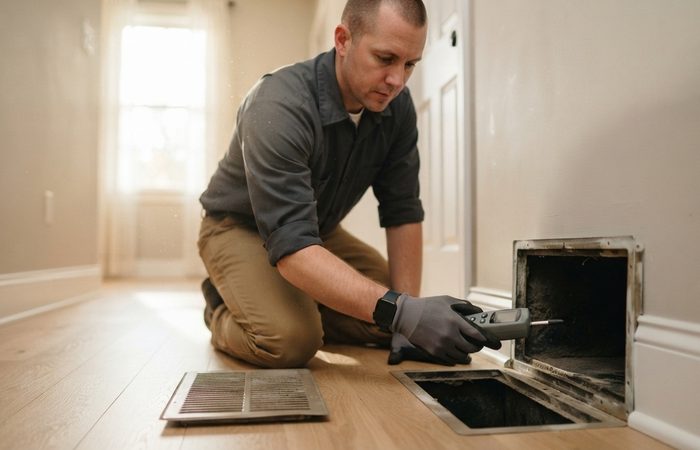
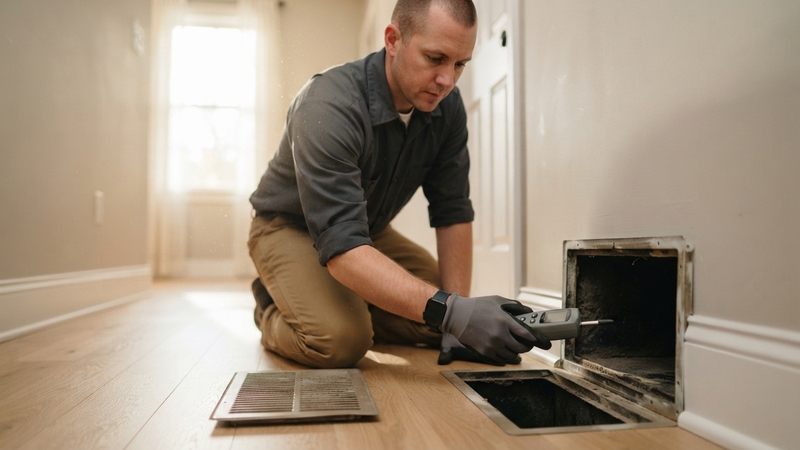
A typical assessment combines a visual inspection with targeted sampling in areas of concern.
| Step | Purpose | Typical Focus Area |
| Visual inspection | Identify visible mold, moisture stains, or ventilation gaps | Basements, attics, HVAC vents |
| Moisture and humidity check | Confirm whether conditions support mold growth | Crawl spaces, bathrooms, laundry areas |
| Duct and vent review | Assess buildup that circulates particulates | Supply and return ductwork |
| Follow-up recommendation | Match findings to next steps, such as cleaning or mitigation | Whole-home or targeted room |
Humidity control plays a central role in this process. The EPA recommends keeping indoor humidity between 30 and 50 percent, and below 60 percent, to limit mold and dust mite activity, which gives homeowners a clear benchmark to check against after any testing visit.
Connecting Testing to Long-Term Air Quality Steps
Testing results are most useful when paired with a corrective action, since a report alone does not change the air inside a home. Common follow-up measures include duct cleaning to remove accumulated particulates, correcting moisture issues in basements or crawl spaces, and improving ventilation in kitchens and bathrooms. Based in Janesville, WI, SE Cleaners LLC follows the same sequence for cleaning and inspection work in Evansville, WI: assess conditions first, then address the identified source.
Property owners should treat a testing report as a starting point rather than a final verdict, since most indoor air concerns involve more than one contributing factor working together. Reviewing duct condition alongside humidity levels and any visible moisture issues gives a more complete picture than checking a single pollutant in isolation.
Frequently Asked Questions
How often should a home be tested for indoor air quality? There is no universal schedule, but testing is commonly recommended after water damage, before moving into a new home, or when household members report ongoing respiratory symptoms without another clear cause.
Does indoor air testing include radon? Radon is a separate test from general indoor air quality sampling, and the EPA recommends checking every home for it regardless of other air quality concerns.
Can duct cleaning improve indoor air quality on its own? Duct cleaning addresses particulate buildup inside the ventilation system, but it does not resolve moisture or humidity issues, which often require separate correction.
Is testing necessary if mold is already visible? Usually not; EPA guidance suggests that visible mold should be cleaned and the underlying moisture source fixed rather than tested first.
Where to Find More Information
SE Cleaners LLC is a cleaning and inspection services company based in Janesville, WI, serving customers in nearby communities, including Evansville, WI. The company provides residential and commercial cleaning and inspection-related services, with business details, service categories, and coverage information available through its Google Business Profile for local property owners researching professional service providers.