Quick take:
• Outdoor lighting fixture choice depends on purpose (safety, security, or ambiance), fixture material, and voltage type before installation begins.
• LED landscape lighting, permanent architectural lighting, and custom exterior fixtures are the most commonly requested outdoor lighting services in the Charlottesville area.
• Professional installation matters most for wiring safety, transformer sizing, and weatherproofing in Virginia’s climate.
Homeowners searching for an outdoor lighting company in Charlottesville VA are typically trying to solve one of three problems: poor nighttime visibility along walkways, a home exterior that looks flat after dark, or outdated fixtures that no longer match the house. The right fixture selection depends less on style preference alone and more on where the light needs to fall and how much maintenance a homeowner wants to take on.
Fixture materials and voltage systems vary widely, which is why many homeowners bring in a professional rather than guessing at big-box store kits. An outdoor lighting company in Charlottesville VA can evaluate a property’s layout, soil conditions, and roofline before recommending specific fixtures, since a path light that works well in flat terrain may underperform on a sloped or heavily landscaped lot. Getting this evaluation done before purchasing fixtures tends to save homeowners from costly reinstalls later.
Matching Fixture Types to Outdoor Lighting Goals
Not every part of a property needs the same kind of light. Matching fixture type to function is the first decision homeowners face.
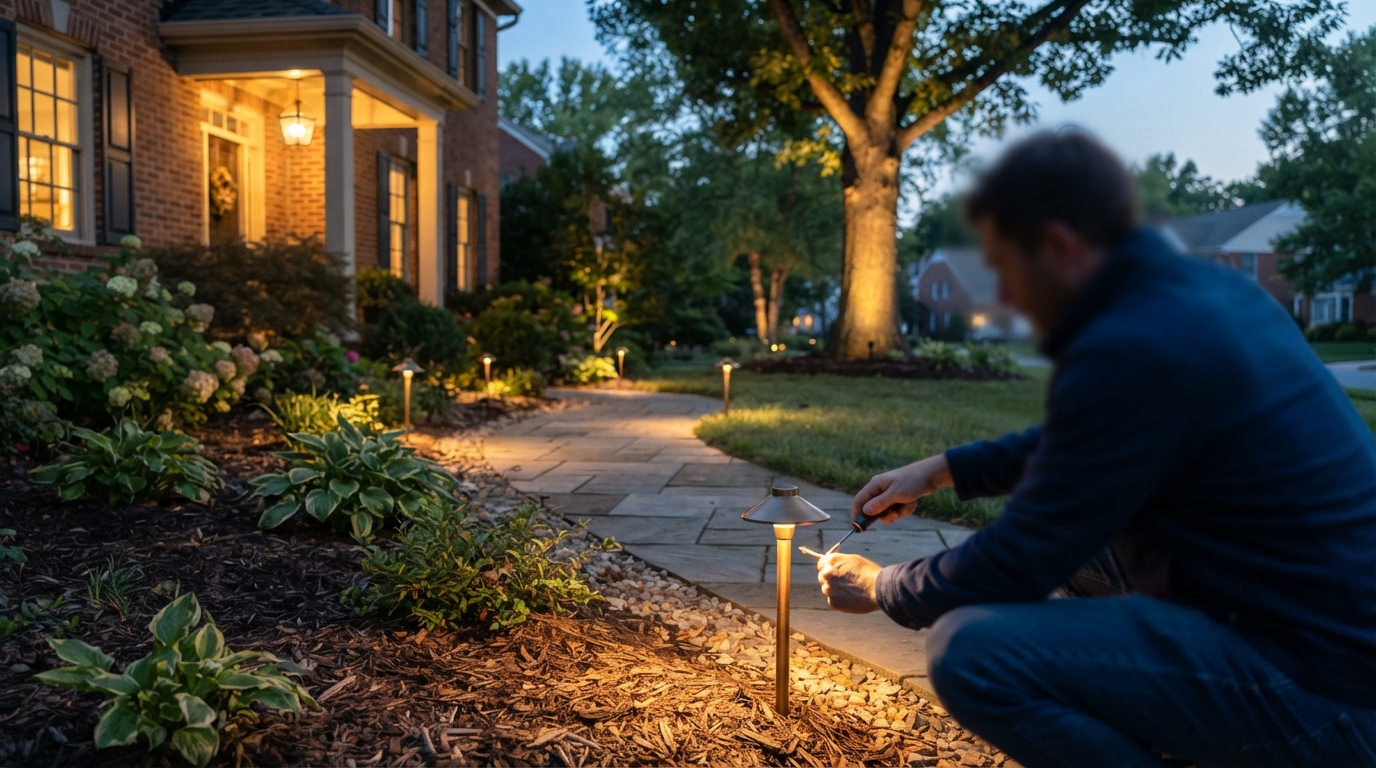
• Pathway and step lights improve safety on walkways and stairs by reducing tripping hazards after sunset.
• Uplights and spotlights highlight trees, columns, or architectural features for a layered nighttime look.
• Soffit and roofline lighting outlines the house itself and can double as a permanent alternative to seasonal string lights.
• Deck and patio lighting extends usable outdoor living space into the evening hours.
Fixture finish also matters in a climate like Virginia’s, where humidity and temperature swings are common. Brass and copper fixtures resist corrosion better over time than painted aluminum, though they cost more upfront.
Low-Voltage vs Line-Voltage Systems
Most residential landscape lighting today runs on low-voltage transformers rather than standard household current, largely because low-voltage systems are safer to install outdoors and cheaper to operate. The table below compares the two approaches homeowners commonly consider.
| Factor | Low-Voltage (12V) | Line-Voltage (120V) |
| Installation safety | Safer for DIY-adjacent work, lower shock risk | Requires licensed electrician, higher risk |
| Typical use | Path lights, uplights, accent lighting | Larger security floodlights, some architectural lighting |
| Energy use | Lower draw, works well with LED fixtures | Higher draw unless paired with LED retrofits |
| Wiring flexibility | Easier to reroute or expand later | More rigid once wiring is set |
Electrical safety guidelines from the U.S. Consumer Product Safety Commission note that outdoor electrical installations carry higher risk of shock and fire when wiring, connectors, or transformers are not rated for exterior exposure. This is one reason many homeowners prefer a licensed installer over a fully DIY approach, particularly for line-voltage runs near decks, pools, or damp soil.
What Professional Installation Adds
Buying the right fixture is only half the process. Placement, wiring depth, and transformer sizing determine whether a lighting system performs consistently for years or needs constant troubleshooting.
A qualified installer typically handles:
1. Load calculations so the transformer is not overworked by too many fixtures on one run.
2. Trenching or securing wiring at a depth that protects it from lawn equipment and freeze-thaw cycles.
3. Weatherproof connections at every junction point to prevent moisture intrusion.
4. Fixture aiming and spacing adjustments after dark, since daytime placement often looks different once lights are actually on.
Advantage Home Lighting, listed on its Google Business Profile as a lighting installation provider serving the Charlottesville area, is one of the local companies homeowners can consult for landscape and exterior lighting projects. Confirming licensing, reviewing past project photos, and asking how a company handles warranty repairs are reasonable steps before committing to any outdoor lighting installer in the region.
Frequently Asked Questions
How many outdoor fixtures does an average home need? This varies by lot size and goals, but most homeowners start with a mix of path lights, one or two accent uplights, and lighting near entry points before expanding further.
Can existing landscape lighting be upgraded to LED? Many low-voltage systems can be retrofitted with LED bulbs or fixtures, though transformer compatibility should be checked first since LED draws far less power than incandescent.
Does outdoor lighting need a permit in Virginia? Low-voltage landscape lighting generally does not require a permit, but line-voltage work tied into a home’s electrical panel may fall under local code requirements, so checking with the county building department is recommended.
What is the difference between security lighting and accent lighting? Security lighting is typically brighter, motion-activated, and placed at entry points or dark corners, while accent lighting is dimmer and used to highlight landscaping or architectural features.
Choosing outdoor lighting fixtures involves balancing fixture material, voltage type, and placement goals against the realities of a specific property. Homeowners who take time to plan for safety, maintenance, and long-term energy use tend to end up with systems that perform well for years rather than requiring frequent rework. For those ready to move from planning to installation, consulting a local specialist remains the most direct way to turn a lighting concept into a working system on an actual Charlottesville property.